CoinMarketCap vs CoinGecko vs CoinPaprika: how crypto ranking sites count, compared
The same question gets answers from 504 to 63.9 million. The difference is what each site decides to call a cryptocurrency.
Which crypto ranking site should you use?
CoinMarketCap and CoinGecko list everything that trades, tokens included, and are the places to look up any price. CoinPaprika and CryptoSlate can separate coins from tokens. CoinSpectrum counts only native cryptocurrencies and filters them by consensus and mining algorithm. LiveCoinWatch and CoinCodex are fast price lists with free tools.
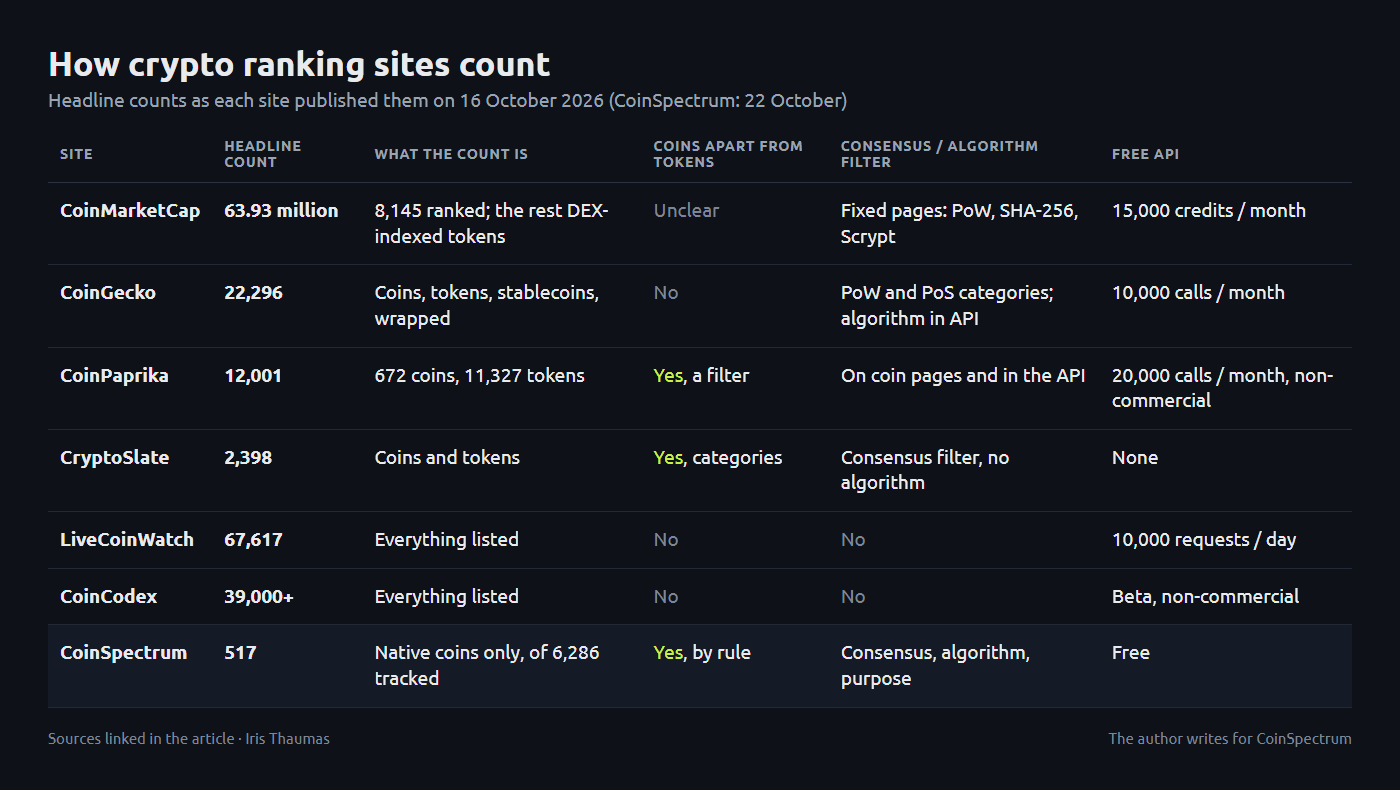
Ask a crypto ranking site how many cryptocurrencies exist and the answer depends entirely on the site. On 16 October 2026, CoinMarketCap's header said 63.93 million. CoinGecko said 22,296. CoinPaprika said 12,001. CoinSpectrum, counting only coins with a blockchain of their own, counts 504.
None of them is wrong. They are answering different questions, and a reader who knows which question each one answers can use all of them better. Every figure below is taken from each site's own pages or API on the date given, and linked at the end.
In one table
CoinMarketCap: the broadest list, owned by an exchange
CoinMarketCap is the oldest of the aggregators, founded in 2013, and has been owned by Binance since 2020. Its headline count of 63.93 million includes every token its DexScan tool indexes automatically across more than 70 networks. Most of those were launched on token launchpads and barely trade after their first day. The ranked list CoinMarketCap actually reviews is far shorter: 8,145 entries.
It is the place to look up the price of almost anything, including a token created this morning. It also keeps fixed "view" pages for proof of work, SHA-256 and Scrypt coins, though not as a filter on the main table. The portfolio needs an account. The API has a free Basic plan of 15,000 credits a month.
The catch is the ownership. A ranking owned by the largest exchange ranks, among other things, that exchange's competitors.
CoinGecko: independent, and the developers' default
CoinGecko is independent and the aggregator most developers start with: a free Demo API with a year of history, and paid plans from $35 a month. Its 22,296 entries mix coins with tokens, stablecoins and wrapped copies under one total. Only about 810 of them have no contract address on another chain, which is a rough count of the native coins among them.
What it does well is categories: 774 curated ones, including proof of work (148 coins) and proof of stake (142). Its API also returns each coin's hashing algorithm and block time, although the site itself does not filter by algorithm.
CoinPaprika: the best structured data of the big three
CoinPaprika's 12,001 active assets carry fields the others do not show: whether each is a coin or a token, its consensus type, its hashing algorithm and its development status. The site can show coins only, and the split is telling: 672 coins against 11,327 tokens. The free API answers without a key, for personal and non-commercial use, up to 20,000 calls a month.
What it lacks is a way to filter by consensus or algorithm on the site. The data is there for anyone who uses the API.
CryptoSlate: news with a directory attached
CryptoSlate is a news publication, founded in Seattle in 2017, that keeps a directory of 2,398 assets. It is one of the few with a real consensus filter on the page (proof of work, proof of stake, delegated proof of stake and masternode) and separate coin and token categories. It does not go down to the mining algorithm.
LiveCoinWatch and CoinCodex: fast lists and free tools
LiveCoinWatch lists 67,617 coins across 1,031 exchanges, with an uncluttered price table and an API that is free outright at 10,000 requests a day. CoinCodex covers 39,000+ assets with long price histories and sector pages. It is best known for its price-prediction pages, which are model output rather than analysis. Neither filters by consensus or separates coins from tokens.
CoinSpectrum: only the coins with their own chain
CoinSpectrum starts from the other end. It counts a cryptocurrency only if it has its own blockchain and its own consensus. Tokens, stablecoins and wrapped copies are listed on separate pages and never added to the total. That leaves 504 native cryptocurrencies out of 6,204 listings tracked: 5,092 tokens, 114 stablecoins and 494 wrapped or staked copies make up most of the rest.
Its filters are the ones the large aggregators lack: consensus family, mining algorithm (with hashrate and daily miner pay), purpose, ledger model and how a coin was first distributed. Its portfolio tracker needs no account, and the API is free. It does not cover DeFi positions or the newest tokens. For those, the aggregators above are better.
Why the counts are so far apart
Three things inflate a count, and each site makes its own choice about them:
- Tokens. A token is an entry in a smart contract on someone else's chain. Launchpads on Solana, Ethereum and Base have created millions of them. CoinMarketCap counts every one its scanner finds.
- Stablecoins. A dollar token is a claim on dollars held by its issuer. It trades, so most sites count it.
- Wrapped copies. Wrapped bitcoin's value is bitcoin held somewhere else. Counting it beside bitcoin counts the same coin twice.
Where a site separates coins from tokens, the native coins turn out to be a small share: 672 of CoinPaprika's active assets, about 810 of CoinGecko's entries and 504 on CoinSpectrum. The number of things that can be bought keeps growing every day. The number of independent blockchains grows slowly.
Which to use for what
- The price of any token, including new ones: CoinMarketCap or CoinGecko.
- A coin's consensus or algorithm as data, for an app: CoinPaprika's API, or CoinGecko's.
- Native coins only, filtered by consensus, algorithm or purpose: CoinSpectrum, or CryptoSlate for consensus alone.
- A free price API without a paid plan: LiveCoinWatch, or the free tiers of CoinGecko, CoinMarketCap and CoinPaprika. Check each licence.
- Long price histories and charts: CoinCodex or CoinGecko.
The fuller comparison, including on-chain and DeFi tools such as DefiLlama, Glassnode, Nansen and Dune, is in Crypto analytics platforms compared. The count itself, refreshed with every build, is in How many cryptocurrencies are there?
Sources
Figures as each site published them on 16 October 2026; CoinSpectrum's are live.
- CoinMarketCap — home page count; ranked list; about; API pricing
- CoinGecko — home page count; categories; API pricing
- CoinPaprika — global count; fields per coin; API pricing
- CryptoSlate — coin directory; about
- LiveCoinWatch — home page count; API
- CoinCodex — home page count; API
- CoinSpectrum — ranking; methodology